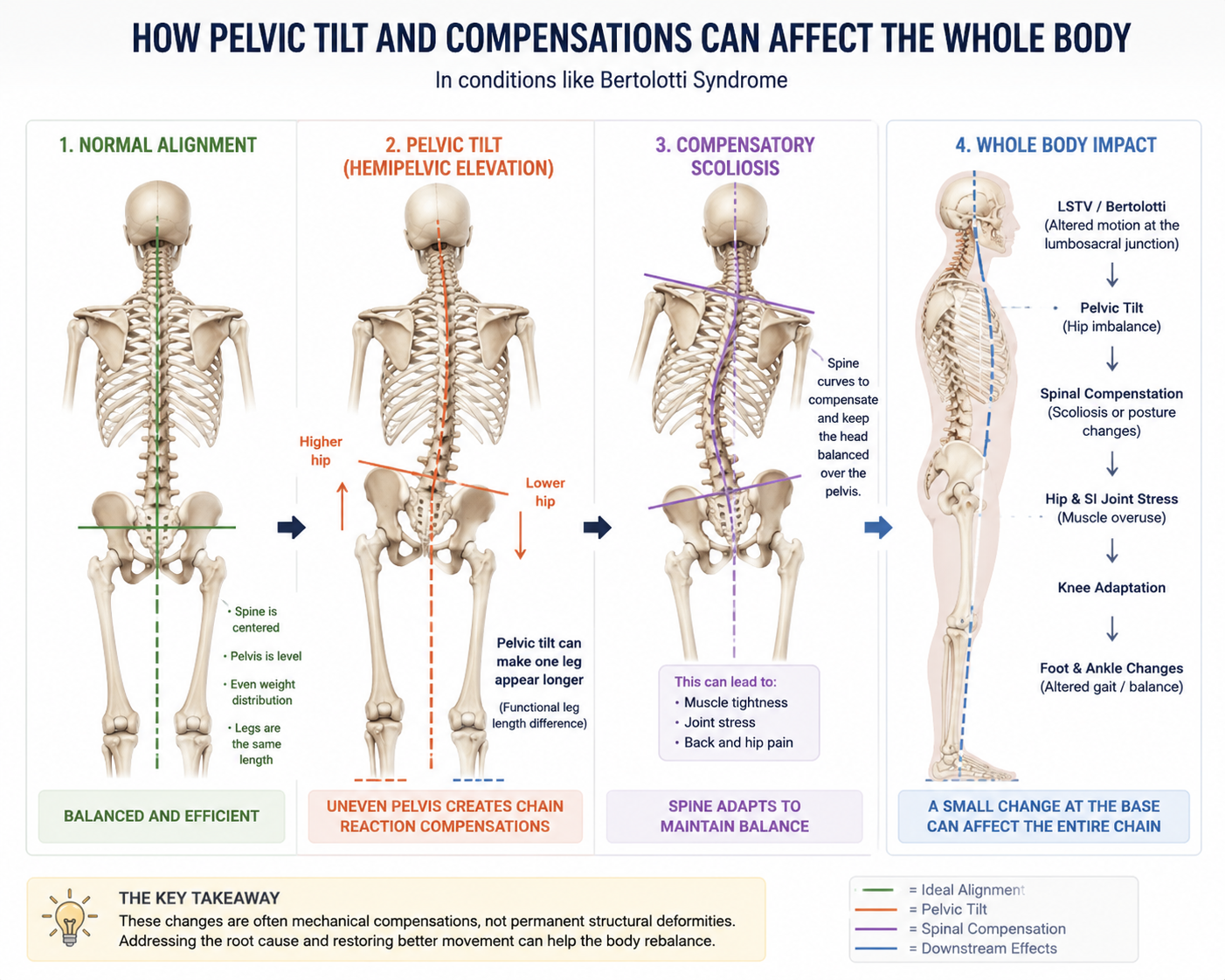
Changes in Spinal and Pelvic Alignment in Bertolotti Syndrome (Bsy)
How does it affect our Body Mechanics?
The human body works as one system. If there is a change in movement in one area, other parts will often change to make up for it. In Bertolotti Syndrome (Bsy), having what is called a lumbosacral transitional vertebra (LSTV) can alter the normal mechanics of the lower spine and pelvis, and eventually lead to various alignment changes.
There is no guarantee that all individuals with Bertolotti Syndrome (Bsy) will exhibit these changes; severity may vary among different persons, the type of LSTV they have could also factor in. However, when an LSTV changes motion at the lumbosacral junction, the body may be forced to change its load and motion patterns at other places to try and maintain balance and function.
Pelvic Tilt and Hemi pelvic Elevation
Asymmetrical movement occurs when one side of the transitional vertebra makes a stronger connection with the sacrum or pelvis than the other. This may lead to a situation wherein one side of the pelvis is higher than the other, commonly called hemi pelvic elevation.
With the uneven development of the pelvis, there may be subtle curves developing in the spine or changes in posture to keep the head over the body. This, in turn, can lead to added stress on the muscles, ligaments, and joints of the lower back and hips.
Functional Leg Length Differences
A tilted pelvis can make it look like one leg is longer than the other, even if the leg bones themselves are an even length. This is called a functional leg length discrepancy.
Gait may be altered, weight may be shifted, and increased muscle activity may occur to reach balance. These compensations over time may lead to pain and fatigue in the lower back, hips, knees, and feet.
Scoliosis and Spinal Curvature
Some patients with Bertolotti Syndrome (Bsy) acquire a mild scoliosis. That is usually labelled compensatory scoliosis since the body develops it to keep the upright position despite the asymmetrical forces at the base of the spine.
In many cases, the curve is relatively small and may get better when we fix the mechanical issue it sits on. But long-standing asymmetrical loading can give the spine more time to adapt.
Sagittal Balance Changes
Sagittal balance: how the body lines up from the side. In an ideal world, the head, spine, pelvis, and lower limbs all team up to hold a nice, easy posture.
An LSTV can change movement and loading patterns at the lumbosacral junction, which may influence lumbar lordosis and pelvic tilt. As compensation occurs, some people may develop postural changes that place increased strain on the muscles and joints responsible for maintaining balance.
Compensatory Changes Above and Below the LSTV
When motion is restricted or altered at one spinal level, neighbouring segments often compensate by moving more than intended. This may contribute to increased stress on adjacent discs, facet joints, muscles, and ligaments. In Bertolotti Syndrome (Bsy), such compensatory mechanisms exacerbate the pain syndrome.
It can also involve compensation below the spine and pelvis, including the hips, sacroiliac joints, knees, and feet. For this reason, symptoms are not always limited to the location of the transitional vertebra itself.
A Whole-Body Mechanical Condition
Bertolotti Syndrome (Bsy) should not always be considered as a solitary abnormality of the spine. In some people, it represents a mechanical condition that can affect the alignment and movement of the whole body.
Knowledge of these compensatory changes may account for the wide variation in symptomatology between different patients and may further explain the necessity for a comprehensive assessment of spinal and pelvic mechanics in determining a treatment plan.